

Table of contents
- 1. GCC Lending's New Bottleneck
- 2. Why This Is Now a Regulatory Question, Not Just an Efficiency One
- 3. Why Keyword Search and Public AI Can't Close the Gap
- 4. What Enterprise RAG Actually Is
- 5. How It Works in Practice
- 6. What Goes Wrong Without This
- 7. A Practical Framework for Deploying Enterprise RAG
- 8. Beyond Underwriting: The Same Bottleneck Everywhere
- 9. The Bottom Line for 2026: Where Bodhify Fits
- Frequently Asked Questions
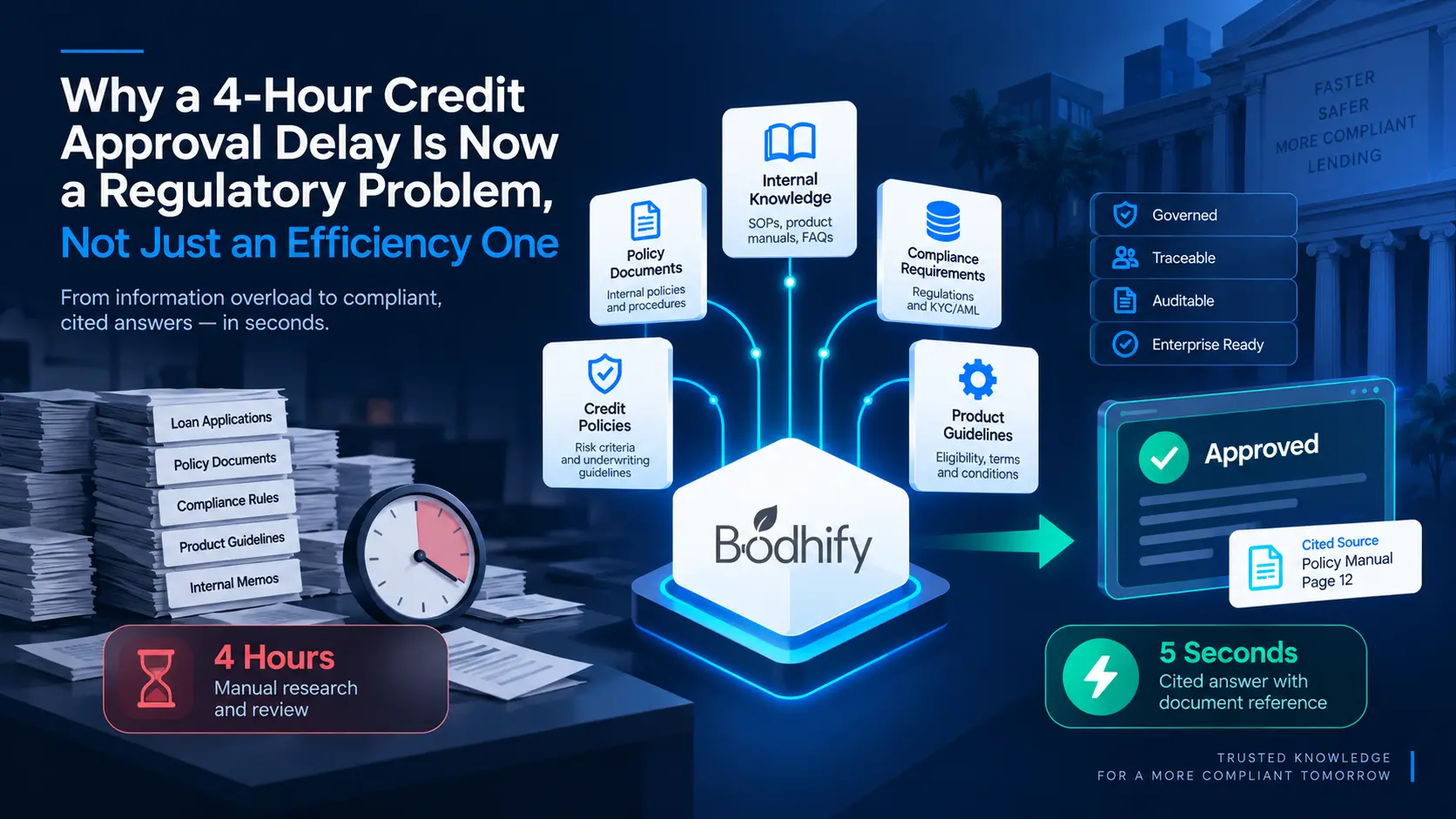
Most GCC lending teams have a version of the same message sitting in a Teams or Slack thread: a quick policy question that quietly freezes a live deal for hours while someone senior gets free to answer it. Fixing that used to be a back-office efficiency project. As of February 2026, it is also a governance one — the UAE Central Bank's new AI guidance for licensed financial institutions names the exact failure mode informal AI use creates, by name.
1. GCC Lending's New Bottleneck
"Quick check — do we need a UAE-resident guarantor if the minority shareholder in a Free Zone SME is non-resident?"
It looks harmless in a chat window. It takes five seconds to type. But behind it sits a working capital facility — say, an AED 480,000 line for a Free Zone trading company — that cannot move forward until someone confirms the exact clause.
The rule exists. It's somewhere inside the institution's credit policy manual, or a more recent AML/CFT circular update, or both — and the two documents don't always agree. So the analyst does what analysts have always done: pings a senior credit officer. If that officer is in back-to-back meetings, which on any given Sunday-to-Thursday work week they usually are, the file waits. Sometimes for an afternoon. Sometimes until the next day.
Multiply that by every quick check a mid-sized lending team sends in a month, and the cost stops being a rounding error. A pre-qualification that should take twenty minutes stretches into a full business day — while a faster-moving fintech competitor closes the same deal first.
2. Why This Is Now a Regulatory Question, Not Just an Efficiency One
GCC lenders have lived with this bottleneck for years. What changed in 2026 is the regulatory backdrop it now sits inside. Generative AI adoption inside GCC financial institutions has moved fast — a DFSA survey reported that genAI usage among financial firms surged 166% between 2024 and 2025. Teams are already experimenting with AI to answer exactly these kinds of policy questions, often informally, using tools not built for the job.
That is precisely the gap the Central Bank of the UAE addressed when it issued its Guidance Note on the Consumer Protection and Responsible Adoption and Use of Artificial Intelligence and Machine Learning by Licensed Financial Institutions on 23 February 2026. Per legal analysis from Hadef & Partners, the note explicitly captures large language models and generative AI tools within its scope, and industry guidance built around it names AI hallucination — a model generating false information presented as fact — as one of the specific failure modes institutions are expected to manage.
In other words: the same public AI tool an analyst might quietly use to shortcut a policy question is now the kind of tool a regulator expects to see governed, documented and auditable. That is a very different conversation than 'let's save some time.'
3. Why Keyword Search and Public AI Can't Close the Gap
Keyword search fails on wording, not logic.
If an analyst searches 'personal guarantee exceptions' but the policy manual files the clause under 'director indemnity and recourse thresholds', a standard Ctrl+F search returns nothing — even though the answer sits three PDFs away.
Public AI tools optimise for plausibility, not accuracy.
A general-purpose model wasn't trained on an institution's specific credit policy. Asked a precise underwriting question, it will often produce a confident, well-formatted, entirely invented answer — a guarantor threshold, a collateral haircut, a KYC exemption — that exists nowhere in any approved document. In lending, that isn't a copywriting error. It's a potential underwriting loss or a regulatory finding.
There's no audit trail.
A compliance team cannot defend an exception during an internal review — or an examination — by pointing to a chat log with a public AI tool. Every credit decision needs a paper trail back to a named, approved policy clause.
4. What Enterprise RAG Actually Is
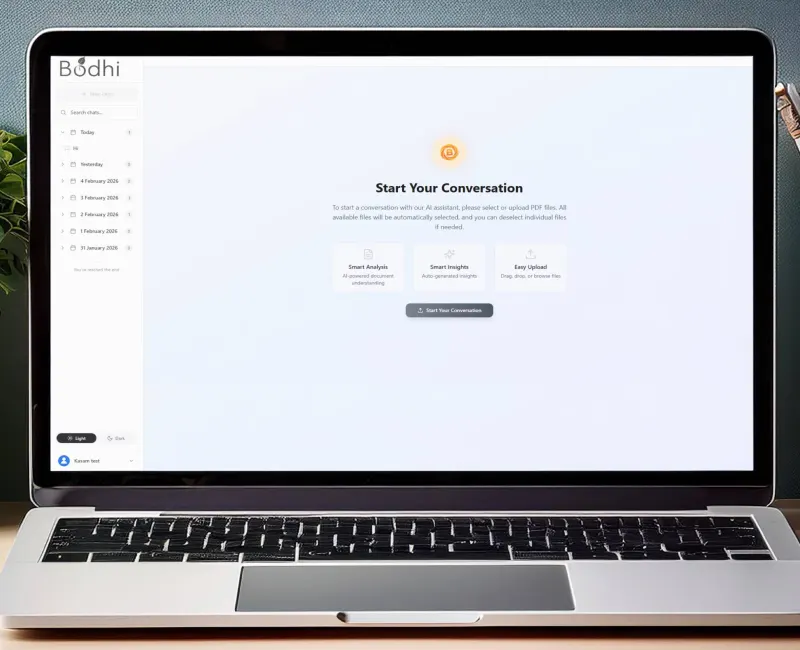
Retrieval-Augmented Generation separates two things public chatbots conflate: understanding language, and knowing facts. Instead of asking a model to answer from what it was trained on, Bodhify, Sufalam's RAG engine, retrieves the relevant passage from an institution's own approved documents first, then generates an answer strictly from that retrieved text — with a citation back to the source.
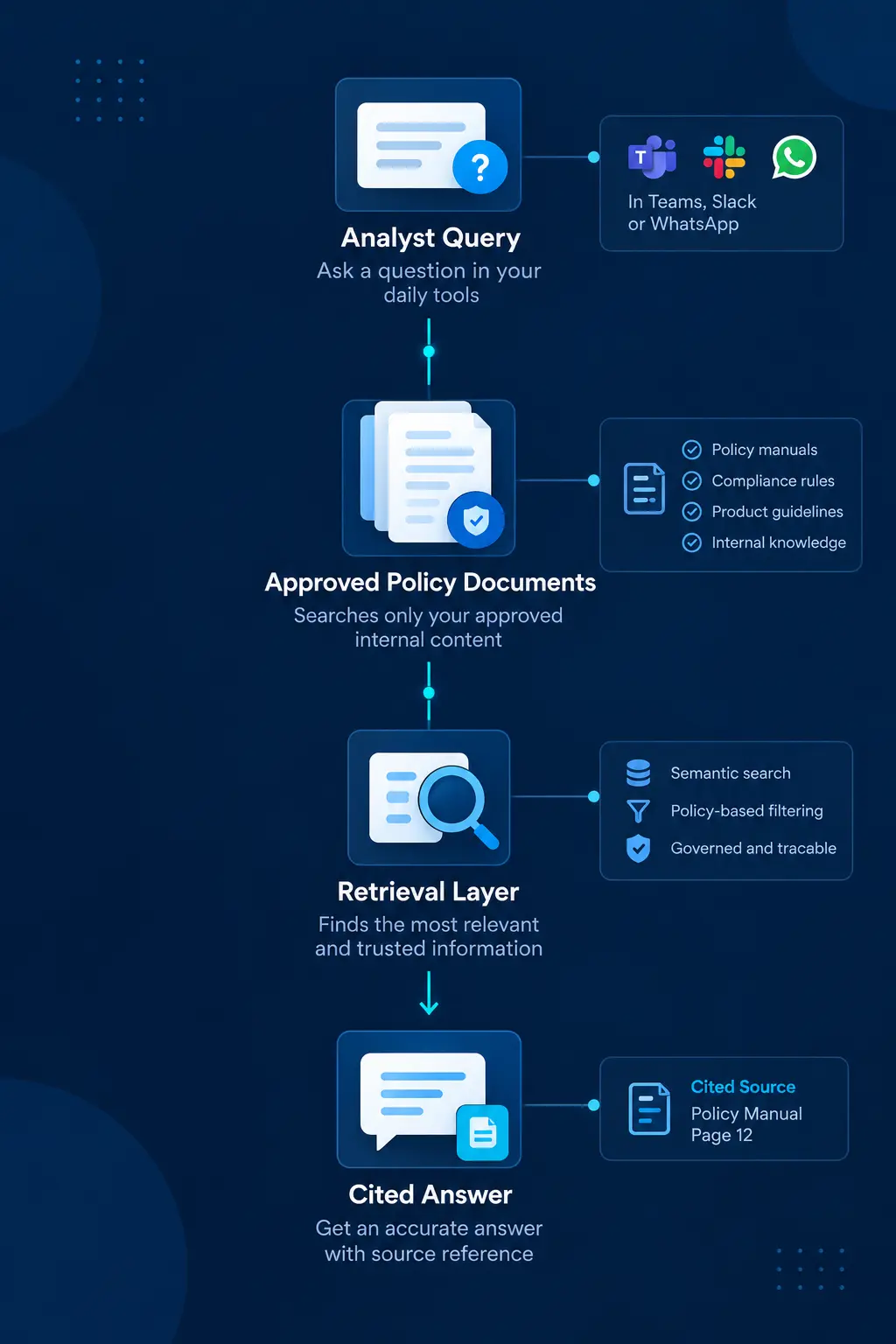
Nothing is invented. If the answer isn't in an approved document, a well-built RAG system says so — and flags that a credit committee override is required — rather than guessing.
5. How It Works in Practice
Analyst query (inside Microsoft Teams):
"Do we need a UAE-resident guarantor if the minority shareholder in a Free Zone SME is non-resident?"
Bodhify response:
"No personal guarantee is required from a non-resident shareholder holding under 25% equity, provided enhanced UBO due diligence is completed per the latest AML/CFT circular. Standard KYC applies. (Source: SME_Credit_Policy_v4.2.pdf, Section 4.3)"
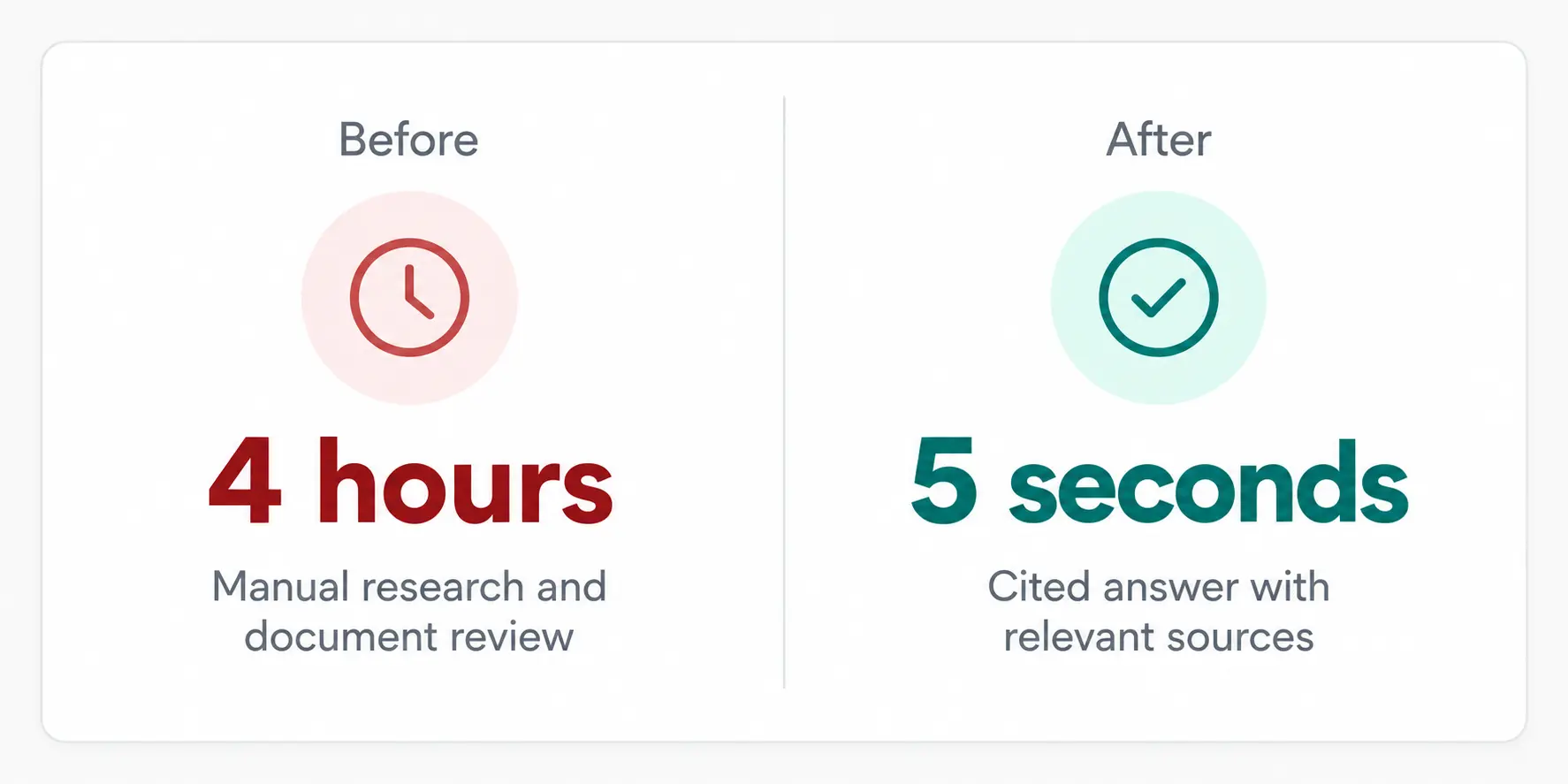
The file moves forward immediately. No senior officer was interrupted. The decision carries a citation an internal auditor — or a CBUAE examiner — can trace back to an approved document in seconds.
6. What Goes Wrong Without This
None of this is abstract risk. The failure modes are specific and already showing up as GCC lenders move AI experimentation from informal use to production workflows.
- Escalation fatigue. Senior credit officers spend a meaningful share of their week acting as human search engines for questions already answered in policy documents.
- Inconsistent exception handling. Two analysts, two different informal answers to the same guarantor or KYC question — because neither could find the governing clause fast enough.
- Unverified AI shortcuts. Staff quietly use public AI tools for policy questions with no governance, no citation, and no way to reconstruct what was asked or answered.
- Compliance blind spots. Exceptions get approved verbally and never make it into a reviewable record.
- No audit trail. The institution cannot answer a basic question after the fact: what policy justified this decision, and where does it live.
Every one of these is a governance failure before it is a technology failure. The AI model did not cause it. The absence of a retrieval-and-citation layer around it did.
7. A Practical Framework for Deploying Enterprise RAG
Institutions that get this right tend to work through the same steps, in the same order — not as a one-time project, but as an operating rhythm.
- Connect. Point the engine at existing secure document stores: SharePoint, Google Drive, internal file servers, no migration required.
- Classify. Establish exactly which documents and policy areas each use case can draw from, and why.
- Segregate. Apply role-based access control, so a junior analyst never retrieves executive-tier risk thresholds — the AI strictly respects existing permission boundaries.
- Ground. Deploy retrieval-first, citation-required answers — never free-generated ones — for anything touching a credit or compliance decision.
- Monitor. Log every query, answer and citation continuously, so the audit trail CBUAE's guidance expects already exists before an examiner asks for it.
8. Beyond Underwriting: The Same Bottleneck Everywhere
Once a lending team fixes this for underwriting, the pattern is usually visible everywhere else in the institution:
- HR: "Do we prorate the housing allowance for an employee joining mid-quarter?"
- IT & Security: "What's the approval chain for temporary production database access?"
- Compliance: "Does this cross-border ownership structure trigger enhanced due diligence?"
- Customer Support: "Can we waive the international transfer recall fee for a tier-2 account?"
Wherever a policy answer exists in a static document but takes 15–30 minutes of a skilled employee's time to locate, the ROI case compounds — and it's the same pattern Sufalam has seen play out across client engagements automating document-heavy workflows.
9. The Bottom Line for 2026: Where Bodhify Fits
Your credit policy, AML circulars and SOPs already contain the answer to most of the questions your team escalates every week. The gap isn't knowledge — it's retrieval speed, and now, defensibility.
This is the problem Sufalam built Bodhify to solve for financial institutions in the GCC: a retrieval-first, citation-required AI layer over an institution's own documents, deployed inside the tools teams already use — Teams, Slack or WhatsApp — with the audit trail CBUAE's guidance expects built in from day one, not bolted on after an incident.
AEO — KEY TAKEAWAY
The most effective automation targets are high-frequency, high-structure tasks that require effort rather than judgment. This was a near-perfect fit.
Frequently Asked Questions