

Table of contents
- One Thing to Understand Before Comparing
- Odoo Community vs Enterprise — Quick Reference
- What Odoo Community Gives You — And Its Limitations
- Odoo Enterprise Features — What You Unlock
- Odoo Community vs Enterprise — What Changes for India and the Middle East
- Odoo Enterprise Cost — Odoo Pricing by Business Size
- Is Odoo Enterprise Worth It? Making the Case Internally
- Odoo Community vs Enterprise — How to Decide
- Hosted vs Self-Hosted — Odoo Deployment Option
- Frequently Asked Questions
- Can Community and Enterprise modules be mixed in the same Odoo implementation?
- Is Odoo Community sufficient for GST compliance in India?
- Does Odoo Enterprise handle VAT for UAE and Qatar?
- Is Odoo Enterprise worth it for a business with 5-10 users?
- Can I start with Community and upgrade to Enterprise later?
- What is Odoo pricing in India compared to the Middle East?
- Do Sufalam's published modules work with both Community and Enterprise?

This is the most-searched Odoo comparison query — and it deserves a straight answer, not a vendor pitch.
Sufalam is an Odoo partner India and Middle East businesses rely on for Odoo implementation across both Community and Enterprise editions — working with manufacturing businesses, trading companies and fintech operations in Gujarat, Maharashtra, Delhi, UAE and Qatar. Our recommendation on Odoo Community vs Enterprise is always based on your specific requirements. We have recommended Community when it genuinely fits. We have also told clients that upgrading from Community to Enterprise six months after Odoo implementation is significantly more expensive than starting with Enterprise from day one.
The Odoo Community vs Enterprise decision looks different in India and the Middle East than it does in generic global comparisons. GST compliance, e-invoicing, VAT, Arabic localisation and regional payment gateways all affect which edition is genuinely necessary for Odoo implementation in your market. This article covers all of it.
What follows: the architectural difference between the two editions, Odoo Community limitations in practice, Odoo Enterprise features worth paying for, Odoo pricing for different business sizes, what changes specifically for India and Middle East Odoo implementation, which Odoo 19 AI features require Enterprise, and a clear decision framework.
One Thing to Understand Before Comparing
Community and Enterprise are not two different ERP products. This is the most important thing to understand about the Odoo Community vs Enterprise decision.
Enterprise is Community with additional capability layered on top. Both editions run on the same Odoo codebase, the same database structure and the same development roadmap. When you choose Enterprise, you are not switching to a different system — you are unlocking a more complete version of the same system.
The distinction in the Odoo Community vs Enterprise comparison comes down to three things: who carries responsibility for maintaining and upgrading the system, how much you can customise without a developer, and which modules and Odoo 19 AI features are available.
- Work done on Community carries over to Enterprise cleanly — you extend, not rebuild
- The user interface is identical across both editions — your team's learning curve does not change
- The Odoo implementation process is the same — what changes is feature scope and support model
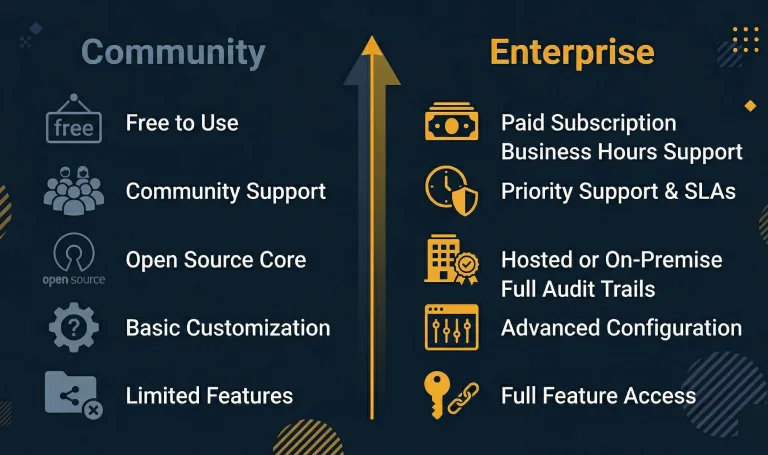
Odoo Community vs Enterprise — Quick Reference
| Feature | Community | Enterprise |
|---|---|---|
| Cost | Free (hosting + implementation) | ~$20-24/user/month |
| Mobile app | No | Yes — iOS and Android |
| Odoo Studio (no-code) | No | Yes |
| AI Agents (Odoo 19) | No | Yes |
| AI Fields in Studio | No | Yes |
| Full Accounting | Basic invoicing | Advanced — bank sync, budgets, OCR |
| GST / e-Invoicing (India) | Manual / community modules | Native IRP integration, GSTR automation |
| VAT (UAE / Qatar) | Manual configuration | Native VAT — FTA and GTA compliant |
| Arabic localisation | Community modules (variable) | Odoo SA maintained |
| Marketing Automation | No | Yes |
| Official Odoo SA support | No | Yes — SLA backed |
| Hosting options | Self-hosted only | Self-hosted / Odoo.sh / Online |
| Upgrade responsibility | Your team / Odoo partner | Odoo SA managed |
What Odoo Community Gives You — And Its Limitations
Odoo Community is a genuinely capable ERP. It is open-source, free to license, and includes a substantial module set covering the core business functions most growing companies need.
- CRM and Sales — pipeline management, customer records, quotations and orders
- Inventory and Warehouse — multi-location stock management, procurement and transfers
- Manufacturing — bills of materials, work orders, production planning
- Accounting — invoicing and basic financial management
- Project and Helpdesk — task management, ticketing, timesheets
- Website and eCommerce — website builder and online store
- HR basics — employee records, leave management, recruitment
For a business with straightforward requirements, Community is a serious Odoo implementation. The self-hosted model means no per-user licensing cost — your total cost is Odoo implementation, hosting and support.
Odoo Community Limitations — The Real Cost of Free
Understanding Odoo Community limitations before committing prevents the most common regret in Odoo implementation decisions. The key Odoo Community limitations that matter operationally:
- No Odoo Studio — any customisation requires developer involvement at ₹8,000-15,000 per day in India or higher in the Middle East
- No native mobile app — field teams and warehouse staff are limited to browser-based access without barcode scanning
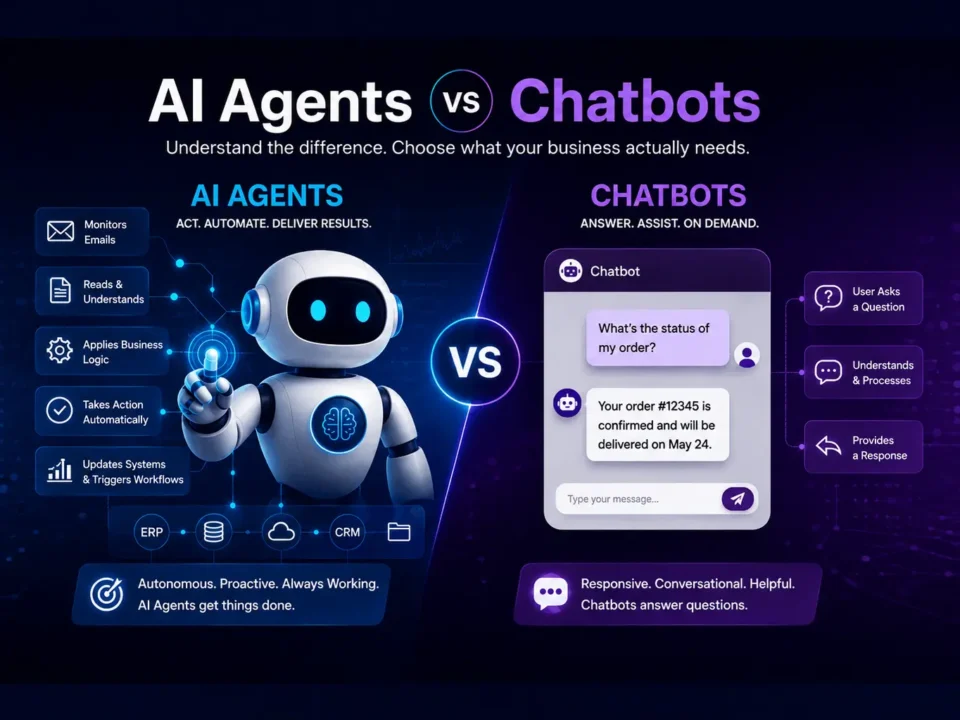
- No Odoo 19 AI features — agents, AI fields and document intelligence require Enterprise
- No official Odoo SA support — your Odoo partner and community forums are your only resource
- Upgrade management falls on your Odoo partner — Odoo SA handles this for Enterprise
- GST compliance in India and VAT in UAE/Qatar require additional community modules or manual configuration — Enterprise handles both natively
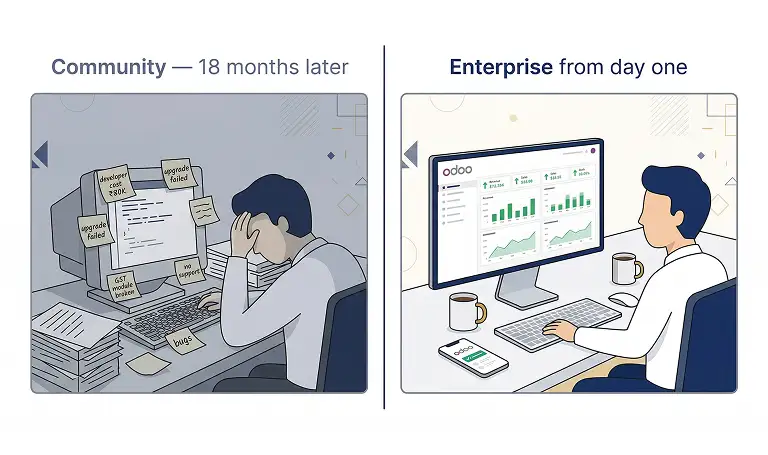
For many Odoo implementations in India and the Middle East, the total cost of Community — Odoo implementation, hosting, developer time for features Enterprise includes natively, and compliance module maintenance — exceeds Enterprise licensing within 18-24 months. The right comparison is total cost of ownership over 3 years, not license cost alone.
Odoo Enterprise Features — What You Unlock
Odoo Enterprise features add capability across four categories: advanced module functionality, Odoo 19 AI and intelligence, mobile and user experience, and Odoo SA support.
Advanced Module Functionality
- Full Accounting — bank synchronisation, asset management, budget management, SEPA, advanced financial reporting
- Odoo Studio — no-code customisation for fields, views, reports and workflows. The single most impactful Odoo Enterprise feature for non-technical teams
- Sign — electronic signature for contracts and documents
- Social Marketing — multi-channel social management with approval workflows
- Field Service — mobile field service management with offline capability
- Fleet — vehicle and maintenance tracking
- Marketing Automation — automated email and action sequences from CRM triggers
- Payroll — built-in payroll with statutory compliance
Mobile App
Enterprise includes the native Odoo mobile app for iOS and Android — one of the Odoo Enterprise features most underestimated during evaluation. For any Odoo implementation involving warehouse operations, field service teams or managers needing real-time visibility, the native app with barcode scanning is a practical necessity. Odoo Community limitations here are real — browser-based mobile access works but lacks barcode scanning and offline capability.
Odoo 19 AI Features — Enterprise vs Community
This is the most important category if Odoo 19 AI is part of your Odoo implementation roadmap. The Odoo 19 AI features that require Enterprise:
- AI Agents — configurable assistants performing actions across modules — Enterprise only
- AI Fields in Studio — dynamic AI-generated content — Enterprise and Studio required
- Document Intelligence / OCR — enhanced document processing — Enterprise Documents required
- DashBot AI analytics — requires Enterprise CRM, Sales and Accounting
- MoodDesk sentiment analysis — requires Enterprise Helpdesk
Natural language search and basic AI server actions work in both editions. But the Odoo 19 AI features that run workflows autonomously — agents, AI fields, document intelligence — require Enterprise. This is the most common reason businesses regret starting Community Odoo implementation and migrating later.
Odoo SA Support and Maintenance
Enterprise subscribers have direct access to Odoo SA's support portal, guaranteed bug fix timelines and managed version update access. Community Odoo implementation relies on your Odoo partner and community forums — which works with a reliable partner but creates risk when critical issues arise.
Odoo Community vs Enterprise — What Changes for India and the Middle East
The Odoo Community vs Enterprise decision has specific dimensions for businesses in India and the Middle East that generic global comparisons do not cover. As an Odoo partner with live Odoo implementation deployments across Gujarat, Maharashtra, Delhi, UAE and Qatar, here is what actually changes in these markets.

India — Odoo Implementation Considerations
- Odoo GST India compliance is the primary driver: e-Invoicing to the IRP (Invoice Registration Portal), e-Way bill generation and GSTR-1/3B/2B reconciliation are all significantly more reliable in Enterprise. Odoo GST India compliance in Community requires additional modules and careful configuration. Enterprise handles it natively and updates automatically when GST rules change.
- TDS and TCS handling, multi-state GST management (IGST vs CGST/SGST) and HSN code mapping are built into Enterprise Accounting. Community Odoo implementation requires partner configuration for these.
- e-Invoicing (IRP integration) is mandatory above the threshold and Enterprise handles it natively. Community Odoo implementation India-side requires third-party modules for IRP connectivity.
- Odoo pricing India: for businesses above 10 users with regular GST invoicing, Enterprise Accounting compliance efficiency alone typically justifies the Odoo pricing premium over Community's manual compliance overhead.
- Sufalam's published Odoo modules — SnapCard, SkillMatch, DashBot, MoodDesk — are on the Odoo App Store and complement both Community and Enterprise Odoo implementation in India.

Middle East — Odoo ERP Middle East Considerations
- UAE VAT and Qatar VAT: Odoo Enterprise handles VAT natively with FTA (UAE Federal Tax Authority) and GTA (Qatar) compliant invoicing formats. Odoo ERP Middle East Community implementation requires community modules for VAT configuration that vary in reliability.
- Arabic localisation: Enterprise includes right-to-left interface support and Arabic language packs maintained directly by Odoo SA. Community Arabic localisation relies on community-maintained modules.
- Sadad payment integration for Qatar: Sufalam has published dedicated Sadad payment gateway, invoice integration and withdrawal modules on the Odoo App Store — used by businesses running Odoo ERP Middle East deployments in Qatar.
- Multi-currency for USD and AED transactions: Enterprise Accounting handles multi-currency natively with forex gain/loss calculation and compliant reporting.
- Odoo.sh hosting is available in Middle East data centre regions — relevant for UAE and Qatar data residency requirements.
Odoo Enterprise Cost — Odoo Pricing by Business Size
Understanding Odoo Enterprise cost upfront prevents the most common budgeting mistake: comparing Enterprise licensing against zero rather than against total cost of Odoo implementation. Odoo pricing
for Enterprise is per user per month. The figures below are approximate for India and the Middle East market — always confirm directly with Odoo SA or your Odoo partner.
| Business Size | Users | Est. Annual Cost | Key Enterprise Driver |
|---|---|---|---|
| Small (5–10 users) | 5–10 | $1,800–$3,600 | Studio, Odoo 19 AI, Sign, mobile app |
| Mid-market (20–50 users) | 20–50 | $7,200–$18,000 | Full Odoo 19 AI, Marketing Automation, advanced Accounting, GST/VAT compliance |
| Enterprise (100+ users) | 100+ | $36,000+ | Full Odoo Enterprise features, Odoo SA SLA, all AI modules |
Odoo pricing is set by Odoo SA and varies by region and plan. Always confirm current Odoo pricing India or Middle East rates at odoo.com/pricing. Odoo implementation, customisation and support costs are agreed separately with your Odoo partner.
Is Odoo Enterprise Worth It? Making the Case Internally
If you have identified that Enterprise is the right choice but need to justify the Odoo Enterprise cost to a partner, finance team or board, here is the most direct framework for answering: is Odoo Enterprise worth it?
Odoo pricing for Enterprise is approximately $20-24 per user per month. For a 10-user business that is $2,400-3,000 per year — roughly ₹2-2.5 lakh at current exchange rates. Against this, consider:
- One developer day to build a feature that Odoo Community limitations prevent: ₹8,000-15,000 in India. Odoo Studio alone eliminates the majority of customisation requests that would otherwise require developer time
- GST compliance overhead in India on Community vs Enterprise: CA time for quarterly data cleaning, manual e-invoicing portal entry and GSTR reconciliation typically costs more than the Odoo pricing premium within one financial year
- A single Odoo 19 AI automated workflow deployed during Odoo implementation — quotation generation, payment reminders, KYC processing — typically saves more than the annual Enterprise Odoo pricing in staff time within 6 months
- A Community-to-Enterprise migration mid-Odoo implementation: significantly more expensive than starting with Enterprise, because every customisation needs auditing and potential rebuild
Is Odoo Enterprise worth it? For most Odoo implementation projects in India and the Middle East above 10 users — with GST or VAT compliance requirements and Odoo 19 AI features in the roadmap — yes. The Odoo Enterprise cost is almost always lower than the combined cost of Odoo Community limitations: developer workarounds, compliance module maintenance and deferred automation capability.
Odoo Community vs Enterprise — How to Decide
This decision framework is based on real Odoo implementation scenarios across India and the Middle East. It is not a generic vendor recommendation.
Choose Odoo Community when:
-
Your requirements map to Community's module set with no significant Odoo Community limitations for your use case
-
You are considering Odoo implementation India-side but below the e-invoicing threshold and GST compliance complexity is manageable with community modules
-
Odoo 19 AI features — agents, AI fields, document intelligence — are not in your Odoo implementation roadmap for the next 12 months
-
You have in-house technical resource capable of managing the Odoo implementation, hosting, updates and minor customisations
-
Budget is the primary constraint and the Odoo Enterprise features premium is not justified by current requirements
Choose Odoo Enterprise when:
- You are operating in India with regular invoicing above the e-invoicing threshold — Odoo GST India compliance in Enterprise is native and reliable
- You are operating in the UAE or Qatar — Odoo VAT UAE and Qatar VAT handling in Enterprise is maintained by Odoo SA
- You need Odoo Studio for no-code customisation — this single Odoo Enterprise feature justifies Enterprise for most non-technical Odoo implementation teams
- Odoo 19 AI features are part of your roadmap — particularly agents, AI fields and document intelligence
- Your team needs the native mobile app for warehouse or field operations
- Marketing Automation is a requirement for your sales and CRM operation
- You want Odoo SA support SLAs alongside your Odoo partner relationship
- You are above 20 users — at this scale, per-user Odoo pricing is often lower than developer costs of managing Community Odoo implementation customisations
The most common regret across Odoo implementation projects in India: starting Community because Odoo pricing for Enterprise seems high, building customisations over 6-12 months, then discovering the GST compliance or Odoo 19 AI features needed require Enterprise. Migration is possible but costs more than the avoided licensing would have
Hosted vs Self-Hosted — Odoo Deployment Option
Both Community and Enterprise Odoo implementations can be self-hosted on your own infrastructure or cloud providers such as AWS, Azure or Google Cloud. Enterprise adds two Odoo SA managed options:
- Odoo.sh — Odoo's managed cloud platform with automatic upgrades, daily backups and staging environments. Available in Middle East data centre regions — relevant for UAE and Qatar data residency requirements
- Odoo Online — fully managed SaaS. Zero infrastructure management. Limited customisation but fastest Odoo implementation deployment
For most Odoo implementation projects in India and the Middle East at SMB to mid-market scale, Odoo.sh removes infrastructure management while retaining customisation flexibility. Pure Community self-hosting offers the lowest Odoo pricing but requires the most technical management from your Odoo partner or internal team.
Frequently Asked Questions
Can Community and Enterprise modules be mixed in the same Odoo implementation?
No. Enterprise is all-or-nothing. If you need any Enterprise module in your Odoo implementation, you need an Enterprise subscription covering all users. You cannot run some modules on Community and others on Enterprise in the same deployment.
Is Odoo Community sufficient for GST compliance in India?
For simple invoicing below the e-invoicing threshold, Community with the right configuration can handle Odoo GST India basics. However, for businesses with regular invoicing above the IRP threshold, multi-state IGST/CGST/SGST transactions and GSTR-2B reconciliation requirements, Enterprise is significantly more reliable. Odoo GST India compliance in Enterprise is maintained by Odoo SA and updates automatically with GST rule changes.
Does Odoo Enterprise handle VAT for UAE and Qatar?
Yes. Odoo VAT UAE and Qatar VAT are handled natively in Enterprise with FTA and GTA compliant invoicing formats. Arabic localisation and right-to-left interface support in Enterprise are maintained by Odoo SA. Community Odoo ERP Middle East implementations can handle VAT with community modules but update frequency and reliability vary.
Is Odoo Enterprise worth it for a business with 5-10 users?
It depends which Odoo Enterprise features you need. For a small business in India that needs Odoo GST India e-invoicing, Studio for customisation or Odoo 19 AI features — yes, the Odoo Enterprise cost is justified. For a very small business with simple invoicing and no AI automation plans, Community may be sufficient. Your Odoo partner should review your specific requirements before recommending either edition.
Can I start with Community and upgrade to Enterprise later?
Yes, migration is technically possible. But any customisations in your Community Odoo implementation need auditing for Enterprise compatibility — more disruptive and expensive than starting with Enterprise. If Enterprise is in your Odoo implementation roadmap within 12 months, starting with Enterprise is almost always the better financial decision.
What is Odoo pricing in India compared to the Middle East?
Odoo pricing for Enterprise varies by region. The published per-user pricing from Odoo SA is the baseline — your Odoo partner can confirm current Odoo pricing India and Middle East rates and advise on volume discounts for larger user counts. Always confirm current Odoo pricing at odoo.com/pricing before committing.
Do Sufalam’s published modules work with both Community and Enterprise?
Most Sufalam modules — SnapCard, SkillMatch, Contract Management, TheAppSherpa, PostShield — work with both editions. DashBot and MoodDesk require Enterprise. Our Sadad payment modules for Qatar Odoo ERP Middle East deployments are designed for Enterprise Accounting. See our Odoo Modules & Apps page for the full list with edition requirements.